Understanding Slip Resistance in Commercial Resin Flooring
Slip resistance is a vital requirement for commercial resin floors, yet it is often misunderstood or oversimplified. In the UK, slips and trips remain a leading cause of workplace injury, with flooring frequently identified as a contributing factor. For facilities managers, architects, specifiers, and building owners, slip resistance is more than just a technical feature; it is a key element of health and safety, compliance, and design responsibility.
Resin flooring systems are popular in food production, healthcare, education, manufacturing, and public buildings because they can be designed to provide reliable slip resistance. However, this performance relies on understanding how floors behave under real service conditions, not just their appearance when newly installed.
Why Slip Resistance Is Critical in Commercial and Industrial Floors
Commercial floors operate under conditions that are fundamentally different from domestic environments. Footfall is higher, cleaning regimes are more robust, contamination occurs more frequently, and users may be wearing specialist footwear. A resin floor that performs adequately in a dry circulation space may pose a significant risk in a wet processing area or a wash-down zone. Slip resistance matters most in hospitals and emergency-service facilities, where wet entrances and round-the-clock foot traffic leave very little room for error.
From a legal perspective, UK duty holders are obliged to minimise slip risks as far as is reasonably practicable. Flooring acts as a permanent, passive control measure. If it is not specified correctly, procedural controls such as signage or training will have limited effectiveness. This is why slip resistance must be considered at the design stage, not retrospectively after incidents occur.
Common Causes of Slips in Commercial Environments
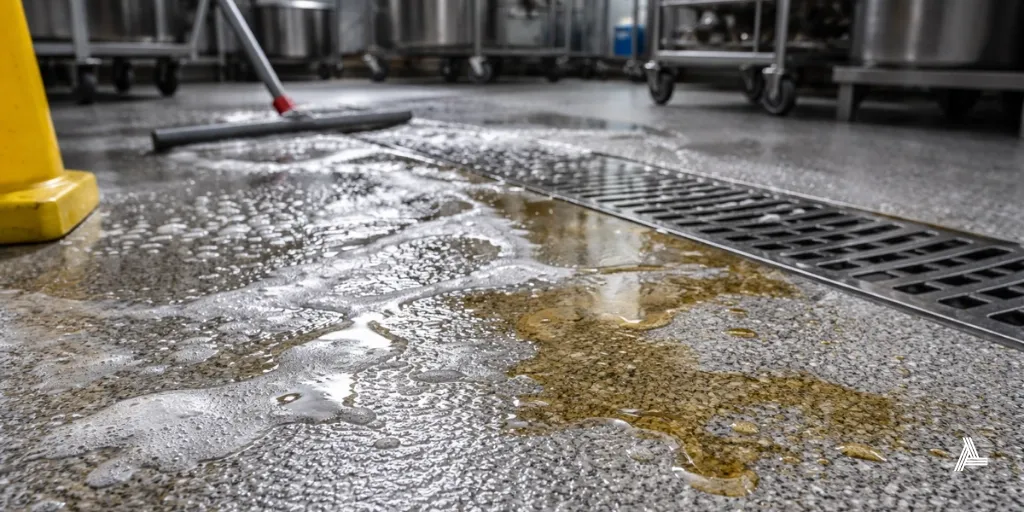
Most slip incidents result from a combination of factors rather than a single failure. Water is the most common contaminant, especially at entrances, in washrooms, and in food-related environments. Even thin layers of water can significantly decrease friction.
Oils and greases pose a greater risk due to their viscosity. In commercial kitchens, food factories, and engineering environments, oily contamination can persist despite regular cleaning, reducing slip resistance if the floor surface is not suitable for it.
Residual cleaning agents are a common yet often overlooked cause. Detergents and surfactants remaining on surfaces can form low-friction films when wetted again, often catching occupants unaware. Poor drainage and inadequate falls worsen these problems by allowing liquids to stay on the surface longer, increasing exposure and spreading contamination.
How Slip Resistance Is Measured in the UK
Slip resistance testing in the UK is based on how people actually move across floors in service. Instead of relying on static measurements, recognised methods assess friction during walking, often under wet or contaminated conditions. This approach offers a more reliable indication of real slip risk in commercial environments.
Pendulum Test Value (PTV)
In the UK, the pendulum test is the most widely accepted method of assessing slip resistance. It measures the dynamic coefficient of friction by simulating a heel strike sliding across the surface. The result is expressed as a Pendulum Test Value (PTV).
The strength of the pendulum test lies in its relevance to human gait. It can be performed on installed floors and in wet or contaminated conditions, making it especially useful for evaluating real-world performance rather than purely theoretical behaviour.
Dynamic Coefficient of Friction
Dynamic coefficient of friction measurements evaluate resistance to slipping after movement has started. This is important because most slips happen during walking rather than when standing still. Therefore, dynamic testing offers a more accurate indication of risk than static methods.
The Importance of In-Situ Testing
Laboratory test results cannot account for installation quality, wear, substrate profile or site-specific contaminants. In-situ testing allows slip resistance to be assessed under actual service conditions and should be considered both after installation and as part of ongoing safety management.
Interpreting Slip Resistance Values in Practice
Instead of seeing slip resistance as a simple pass or fail, it should be viewed as a continuum of increasing risk. Lower values suggest a higher risk of slipping under test conditions, while higher values suggest a lower risk.
Indicative Relationship Between PTV and Slip Risk
| Pendulum Test Value (PTV) | Indicative Slip Risk | Practical Interpretation |
|---|---|---|
| Below 25 | High risk | Likely to present an unacceptable slip hazard in most commercial settings |
| 25 to 35 | Moderate risk | May be acceptable in controlled, dry environments but unsuitable for wet or contaminated areas |
| 36 and above | Lower risk | Generally suitable for pedestrian areas when tested under relevant conditions |
These values must always be understood in context. A floor that achieves a satisfactory PTV when tested with water in wet conditions may perform very differently when exposed to oils or cleaning residues.
The Role of Contaminants and Viscosity
One of the main factors influencing slip resistance is the type of contaminant on the floor. Liquids with different viscosities react very differently under load.
Low-viscosity liquids such as water are more easily displaced, allowing footwear to contact the surface texture. Higher-viscosity contaminants like oils and fats resist displacement, forming a lubricating film that can significantly reduce friction.
Indicative Relationship Between Contaminant Type and Required Surface Profile
| Typical Contaminant Type | Relative Viscosity | Implication for Floor Design |
|---|---|---|
| Clean water, soft drinks | Low | Fine, controlled surface texture may be sufficient in many environments |
| Soapy solutions, milk | Low to medium | Moderate surface profile required to disrupt liquid film |
| Cooking liquids, stocks | Medium | More pronounced texture needed to reduce slip risk under contamination |
| Oils and fats | High | Surface must be specifically designed and tested for oily conditions |
This emphasises why slip resistance cannot be specified on its own. The anticipated contaminants must be identified early, and testing should mirror those conditions.
Surface Texture, Roughness and Misconceptions
It is commonly believed that increasing surface roughness will automatically improve slip resistance. However, the relationship is more complex in practice. Surfaces that are excessively rough can trap contaminants, making effective cleaning difficult and allowing lubricating films to build up over time. They can also cause additional wear on footwear and cleaning equipment, and may raise hygiene concerns in sensitive environments.
On the other hand, well-designed resin floors thoughtfully incorporate controlled surface textures to offer slip resistance, all while being easy to clean and long-lasting. Keep in mind, just looking at a floor’s appearance doesn’t always tell the full story about how well it performs. To truly know if a surface offers sufficient slip resistance, it’s important to conduct testing under realistic conditions.
Drainage, Falls and Surface Regularity
Slip resistance cannot make up for poor floor design. Resin floors follow the shape of the substrate beneath, so inadequate inclines or uneven surfaces will cause ponding. In wet environments, floors should be planned to promote effective drainage towards outlets. Insufficient or inconsistent falls prolong the presence of contaminants on the surface and greatly increase slip risk.
Surface regularity should therefore be addressed alongside slip resistance during design and substrate preparation. Ignoring this relationship is a common cause of underperforming floors.
Cleaning Regimes and Long-Term Slip Performance
Using incorrect detergents can leave residues that lower friction. Infrequent or ineffective cleaning can cause oils and greases to build up. Abrasive cleaning methods can unpredictably change surface texture.
Creating a thorough cleaning plan is a great way to keep your flooring in top shape. This involves choosing the right cleaning products, setting a regular cleaning schedule, and checking slip resistance from time to time. Doing so helps ensure your floor stays safe and looks great for many years to come.
Practical Guidance for Correct Specification
A good starting point is to understand how the space will be used, which helps in planning effectively. Consider factors like potential contaminants, traffic flow, footwear, cleaning routines, and drainage needs to ensure everything is well thought out and tailored to your needs.
Slip resistance ought to be specified through performance standards, supported by standardized test methods and clear acceptance criteria. In environments with higher risk or greater complexity, it’s crucial to consult with seasoned resin flooring experts early on to coordinate surface design, drainage solutions, and maintenance plans. Making these decisions early proves far more efficient than implementing corrective measures after installation.
Designing for Real Conditions
Achieving slip resistance in commercial resin floors is about more than just texture. It involves thoughtful design that takes into account factors like contamination, drainage, cleaning, testing, and long-term wear, to create a safe and durable surface.
By considering slip resistance early in the design process and verifying performance through suitable on-site testing, duty holders can greatly lower the risk while still ensuring that the area remains easy to clean and operates smoothly.