Crack monitoring sensor.
Measures crack width change from 0.003 mm, wireless, fitted in under ten minutes.
A crack is a finding; what matters is whether it moves. A displacement transducer bridging the crack records every change in width at the configured interval, the readings go over NB-IoT to the Allbase portal, and an alarm goes out automatically when a set threshold is exceeded. Three power versions share identical measuring technology: solar, long-life battery or fixed mains.
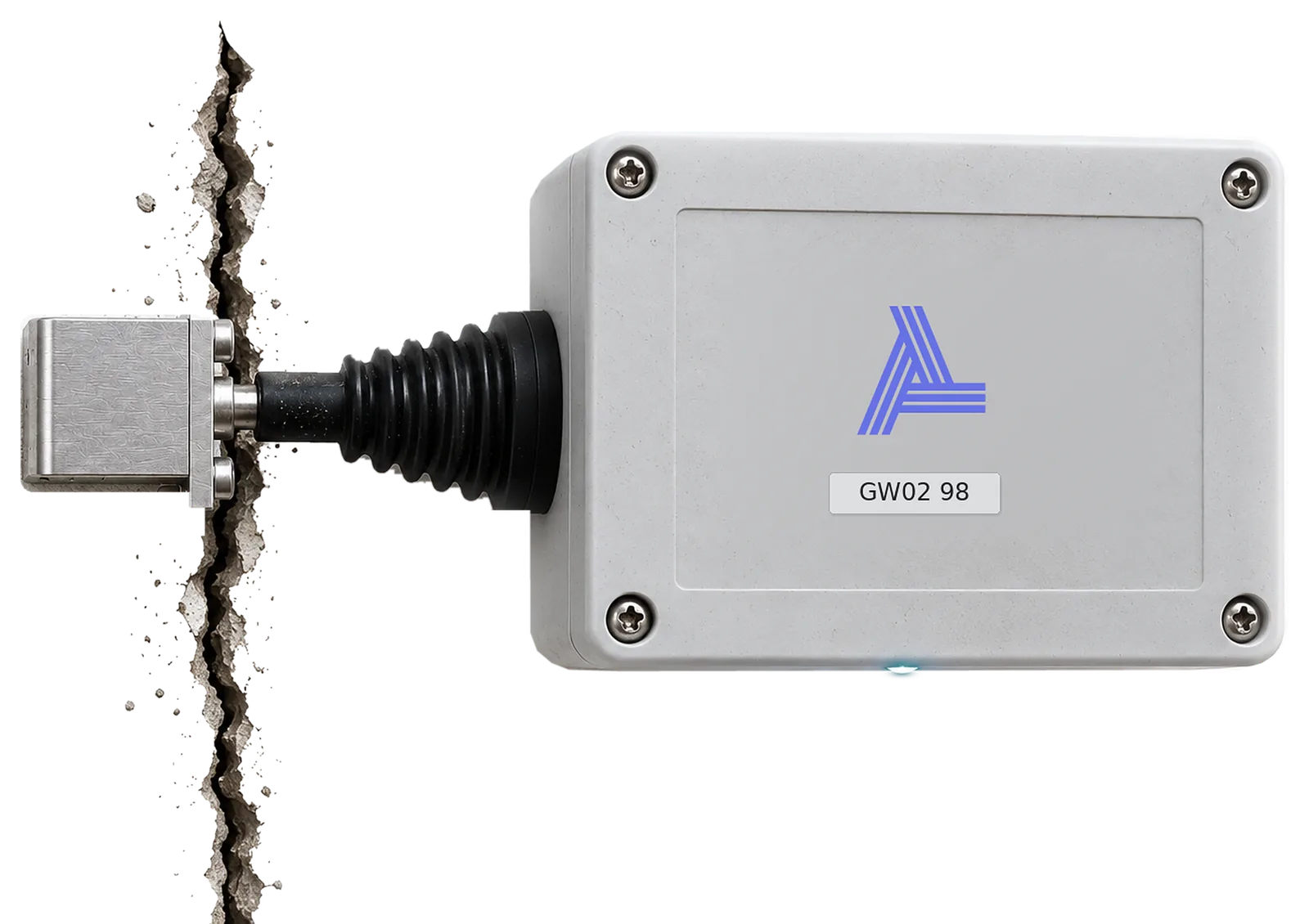
Resolution from 0.003 mm.
Technical dataSolar, battery or fixed mains power.
VersionsSelf-installed in under ten minutes.
How it worksAlarm when a threshold is exceeded.
Alert optionsFrom a visual finding to a solid trend.
A crack is at first only a finding. What matters is whether it changes, and that is measured over weeks and months without anyone needing to be on site.
The integrated displacement transducer captures small, slowly progressing movements long before they are noticeable to the eye, at a measuring interval set anywhere from once a week to once every three minutes, depending on the power supply. If the change in crack width exceeds the configured thresholds the alarm goes out automatically, instead of waiting for the next inspection.
Fitting is self-installation: an adhesive mounting plate with a clip system, no drilling and no cabling, done in under ten minutes. When a monitoring task is complete the sensor is released from the plate and used again on another structure. One unit can be expanded with up to twenty wired crack transducers, so several cracks on one structure share a single device and a single data connection.
How the crack monitor works.
Measurement does not take place in the housing but at the displacement transducer that bridges the crack. One side is fixed, the other follows the movement, and that difference is the crack width change.
- 1
Capture
The integrated displacement transducer measures the change in crack width with a resolution of 0.003 mm, at the configured interval.
- 2
Transmit
The readings go over NB-IoT, directly across the mobile network to the Allbase portal, with no separate device on site.
- 3
Assess
A time series builds up in the portal. When a threshold is exceeded, the alarm goes out automatically.
Same measuring technology, three power supplies.
Measuring principle, resolution, mounting and connectivity are identical across all three. The mounting location decides which one fits.
Solar
For outdoor locations. Permanent operation from the integrated solar cell, no battery replacement, and it sustains high measuring frequencies, which suits long-term monitoring.
Long-life battery
For shaded, covered and enclosed locations. Up to 16,000 measurements per battery cycle, economical for shorter periods, same measuring technology and resolution.
Fixed mains
Where a connection already exists at the measuring point. No replacement and no need for light, same measuring technology and resolution.
Technical data.
Published technical data for the sensor. An Allbase product sheet will follow.
| Measured quantity | Crack width change |
|---|---|
| Resolution | 0.003 mm |
| Power supply | Solar, long-life battery or fixed mains power |
| Data transmission | Narrowband IoT (NB-IoT) |
| Measuring interval | From once a week to every 3 minutes, depending on the power supply |
| Ingress protection | IP67 |
| Mounting | Self-installation in under 10 minutes, adhesive mounting plate with clip; releasable and reusable |
| Optional measured quantities | Concrete temperature, surface moisture |
| Expandable | By up to 20 wired crack transducers |
Where cracks get watched.
Concrete, masonry and render, indoors and out, wherever a crack has been marked and someone needs to know if it is moving.
Car parks and concrete frames
Decks, beams and columns in multi-storey and underground car parks, where a marked crack needs a trend rather than a photo.
Bridges, tunnels and retaining structures
Viaducts, tunnel linings, dams and reservoirs: long-term crack monitoring where access is costly.
Facades and finishes
Rendered facades, ceilings and tiled walls, where a crack path drawn at inspection can be followed between visits.
Every crack movement in view.
As long as the crack width stays within its target range the portal reports nothing. If it exceeds the stored threshold, the alarm goes out automatically, with the whole history behind it.
How an alert reaches you.
Warning and alarm thresholds are set for each measuring point. The sensor reports at its interval, the portal checks every reading against them, and the people on the list hear the moment a threshold is crossed.
Questions about the crack monitoring sensor.
What is included?
The crack sensor in the chosen version with its integrated displacement transducer, the adhesive mounting plate with clip system, and access to the Allbase portal. An ongoing fee covers operation, data storage and platform use.
How is it mounted?
As self-installation in under ten minutes. The sensor fixes to the structure with an adhesive mounting plate and a clip system, with no drilling and no cabling. The plate releases again, so the sensor can be reused on another structure.
How do the readings get out, and what range does it have?
The sensor sends its readings over NB-IoT directly across the mobile network, so it is not tied to a local wireless range or a site network. It works wherever there is NB-IoT coverage, with no separate transmission device on site.
Which of the three versions is right?
The mounting location decides. Solar runs permanently from its integrated cell and suits long-term outdoor monitoring at a high measuring frequency. The long-life battery gives up to 16,000 measurements per cycle and suits shaded locations or shorter periods. Fixed mains is for a measuring point that already has a supply. Measuring technology and resolution are the same across all three.
Can one sensor cover several cracks?
Yes. The unit can be expanded with up to twenty wired crack transducers, so several cracks on one structure are monitored through a single device and a shared data connection.
How do I see the readings?
In the Allbase portal, as a time series for each measuring point. When a preset threshold for crack change is exceeded the alarm goes out automatically by email or text message, and ongoing operation is available as a service.
Ready to start?
Request access to browse and specify, or schedule a consultation to talk through your crack monitoring sensor requirements with one of our specialists.
Schedule a consultation
Arrange a call with a specialist to talk through the structure, the measuring points and the thresholds that matter.
Choose a time