Structural and roof load monitoring.
Laser deflection measurement of the load-bearing structure, with an automatic alarm before a load becomes an overload.
Snow, standing water and wind all load a wide-span roof, and the first reliable sign of trouble is the structure starting to bend. Laser sensors on the load-bearing structure measure that deflection continuously against a reference taken at commissioning, and an alarm goes out automatically when a set limit is reached, so the decision to clear the roof or close the building rests on a measurement, not a look at the roof.
Measures deflection of the structure itself.
How it worksAutomatic alarm when a limit state is reached.
Alert optionsRetrofits to an existing structure.
The systemThresholds set to Eurocode 1 snow loads.
CommissioningWhen the load on the roof becomes a hazard.
Wide-span roofs carry whatever the weather leaves on them, and give very little warning when it is too much.
Wet snow across a large roof quickly adds up to several tonnes on the load-bearing structure. If the drains are blocked, water collects in the hollows and loads the roof unevenly on top of that. Gusts and wind suction add changing loads that wide spans feel most, and over the years the recurring load cycles and temperature swings fatigue the material. Logistics, industrial and sports halls have the largest spans, and they react to overload the most sensitively.
Instead of trying to weigh the load, the system measures what the load does to the structure. Laser deflection sensors on the load-bearing members record how far the roof deforms under whatever is on it, which is a reliable indicator of a possible overload. The readings are compared continuously with a reference captured at commissioning, and when a set limit state is reached the alarm goes out automatically. That early warning is the crucial few hours an operator needs to clear the building or remove the snow.
Laser-based structural monitoring.
A reference at commissioning, continuous deflection measurement, and an alarm at the agreed limit.
- 1
Reference measurement
The initial condition of the roof structure is captured at commissioning and documented. Every later reading is assessed against it.
- 2
Deflection measurement
The sensors measure the deformation of the load-bearing structure continuously, and the readings are collected in a data logger that can be read remotely.
- 3
Threshold alerting
When a defined limit state is reached the alarm goes out automatically, by email and text message, wherever the people who need it are.
Sensors, gateway and portal.
Three parts, all retrofitted to the structure you already have.
Laser deflection sensors
Mounted on the load-bearing structure at the measuring points agreed for the building. They record how far the structure deforms under the current load, and they can be fitted to an existing roof without a new build or major structural work.
Gateway and data logger
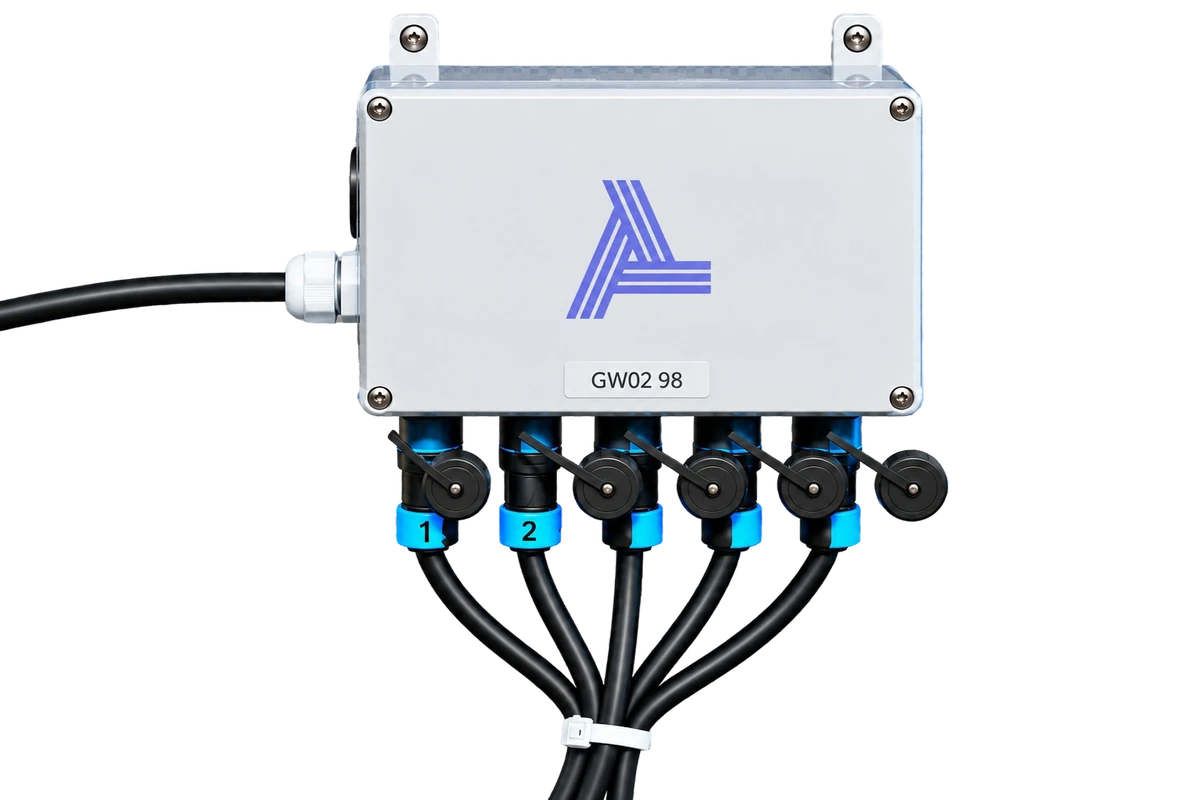
The sensors cable to a wall-mounted gateway with six connections that logs the readings and passes them to the portal. The data can be retrieved remotely or on a mobile device on site.
The Allbase portal
Shows the load state of every measuring point against its thresholds, keeps the history and sends the alarms. Two threshold levels, a warning and an alarm, are set for each structure.
System at a glance
Product sheet to follow. The rows below are limited to what is published today.
| Measured | Deflection of the load-bearing structure, by laser, continuously against a documented reference measurement |
|---|---|
| Data | Collected in a data logger, retrievable remotely and on a mobile device; load states visualised in the portal |
| Thresholds | Warning and alarm levels set for the structure and its load cases, in line with the Eurocode 1 snow load standard (EN 1991-1-3) |
| Alerts | Automatic when a limit state is reached, by email and text message |
| Installation | Retrofittable to existing roof structures; commissioned with a documented reference measurement |
| Suitable for | Wide-span roofs: logistics and warehouse halls, industrial halls, sports and ice halls, exhibition halls, stadiums |
From concept to operation.
One point of contact, from the first measuring point to round-the-clock monitoring.
- 1
Concept
The measuring points, the relevant load cases and the thresholds are defined for the structure and the way the building is used.
- 2
Installation
The sensors are mounted on the load-bearing structure and commissioned with a documented reference measurement.
- 3
Maintenance and operation
Continuous measurement, maintained sensors and reliable evaluation over the whole service life of the system.
- 4
Monitoring and alerting
Round-the-clock remote monitoring with automatic alerting as soon as a limit state is reached, available as an ongoing service with evaluation included.
What a quote needs
The building, its span and the type of roof structure. From that the measuring points and the number of sensors are recommended, with a no-obligation quote to follow.
Existing buildings
The sensors are retrofittable and remotely queryable, so an existing hall can be monitored without a new build or major structural intervention.
Buildings with wide-span roofs.
Wherever a large roof carries a load that changes with the weather.
Logistics and warehouse halls
Large spans over stock, racking and people, where an early warning gives time to clear the building or the roof.
Industrial and exhibition halls
Production and exhibition roofs that cannot simply be closed on a hunch, so the decision rests on measured deflection.
Sports halls, ice rinks and stadiums
Roofs over crowds, where the load cases are known and the thresholds can be set to them.
Load states, made visible.
Every sensor shows its deflection against the threshold, so whether to clear the roof or keep running is decided on a measurement rather than a glance at the roof, at night and at weekends included.
How an alert reaches you.
Two thresholds, set for the structure: a warning as the load builds and an alarm at the limit. They are agreed together, based on the structure and its load cases and in line with the Eurocode 1 snow load standard, so an alarm means something specific to the building.
Questions about roof load monitoring.
How is the roof load monitored?
Instead of weighing the load directly, the system measures the deformation of the load-bearing structure. Laser-based deflection measurements record how much the roof deforms under the current load, which is a reliable indicator of a possible overload.
When am I alerted?
When a predefined limit state is reached. The thresholds are set together, based on the structure and the relevant load cases and in line with applicable snow load standards such as Eurocode 1 (EN 1991-1-3), with a warning level before the alarm level.
Can it be fitted to an existing building?
Yes. The sensors are retrofittable and remotely queryable, and they can be installed on an existing roof structure without a new build or major structural intervention.
Which buildings is it suitable for?
Wide-span roof structures above all: logistics and industrial halls, sports and ice halls, exhibition halls and stadiums. The same measurement technology is also used on bridges.
How do I see the readings?
The readings are collected in a data logger and can be retrieved remotely or on a mobile device on site. The portal visualises the load state of each measuring point against its thresholds and keeps the history.
Who sets it up and runs it?
The measuring points, load cases and thresholds are defined for the structure before anything is fitted, the sensors are installed and commissioned with a documented reference measurement, and ongoing monitoring with evaluation and alerting is available as a service. Request a quote with the building and its span and the rest follows.
Ready to start?
Request access to browse and specify, or schedule a consultation to talk through your roof load monitoring requirements with one of our specialists.
Schedule a consultation
Arrange a call with a specialist to talk through the building, its span and the load cases that matter.
Choose a time