The race to build 100 aircraft a month: can composites keep up?
Why the next jet is a manufacturing problem, not a materials one.
The bottleneck in the next generation of aircraft will not be whether composites are strong enough. It will be whether the supply chain can make them fast enough.
Airbus and Boeing are preparing the aerospace industry for a step change in output. Reuters reported from this year’s JEC World composites fair in Paris that both planemakers are quietly telling the materials industry to be ready for build rates approaching 100 single-aisle aircraft a month each, a pace one source described as roughly one 200-seat jet every few hours. That is more than double Airbus’s current narrow-body run rate, and well beyond anything the industry has attempted with composite structures.
The headline number is striking, but it is the reasoning behind it that matters for anyone who specifies or sources advanced materials. The constraint the manufacturers are wrestling with is not material performance. Carbon fibre and epoxy already do the job structurally. The constraint is manufacturing speed.
What follows is the evidence, in four parts: the demand that justifies the ambition, the bottleneck standing in the way, the material the industry is betting on to break it, and the catch that means the change will be gradual rather than overnight.
Demand is real, and it is documented
This is not a speculative future. The order books already justify the ambition. Airbus closed 2025 with a year-end record backlog, the overwhelming majority of it narrow-body A320neo family jets, and that backlog has continued to climb through 2026. At the company’s targeted delivery rate, it represents around ten years of production.
Demand, in other words, is not the question. The question is whether the materials supply chain can be re-engineered to feed it.
The ramp is already underway
Deliveries have climbed every year since the pandemic. Airbus handed over 793 commercial aircraft in 2025 and has guided to around 870 for 2026, a near ten per cent year-on-year increase.
The A320 programme is being driven towards a rate of 70 to 75 aircraft a month, now expected in the 2027 window after repeated supplier-driven delays.
Why the autoclave is the choke point
Today’s composite structures are almost entirely thermoset: laid up and then cured for hours in an autoclave, a large pressurised oven. It delivers excellent parts, but it is slow, energy-hungry and capital-intensive.
Cure cycles of that length are tolerable at a few dozen aircraft a month. They become an immovable wall at a hundred.
The thermoplastic case
Unlike a thermoset, a thermoplastic matrix can be reheated and reshaped after forming. It hardens by melting and solidifying rather than by an irreversible cure, so cycle times depend on how fast a part can be heated and cooled, not on hours of curing.
A US Department of Energy and Boeing project put the contrast simply: cycle times in minutes rather than hours, with a 75 per cent improvement in energy efficiency. Thermoplastic parts can also be welded instead of riveted.
The catch: cost, certification and a thin supply base
High-performance thermoplastic matrices such as PEEK and the PAEK family are expensive, and a finished thermoplastic part can cost at least twice a comparable metal part today. The processing equipment runs well above 300 degrees Celsius.
Certification is the slower hurdle. Aerospace qualifies materials over years, not months, and the supply base is still thin.
Why the next single-aisle matters
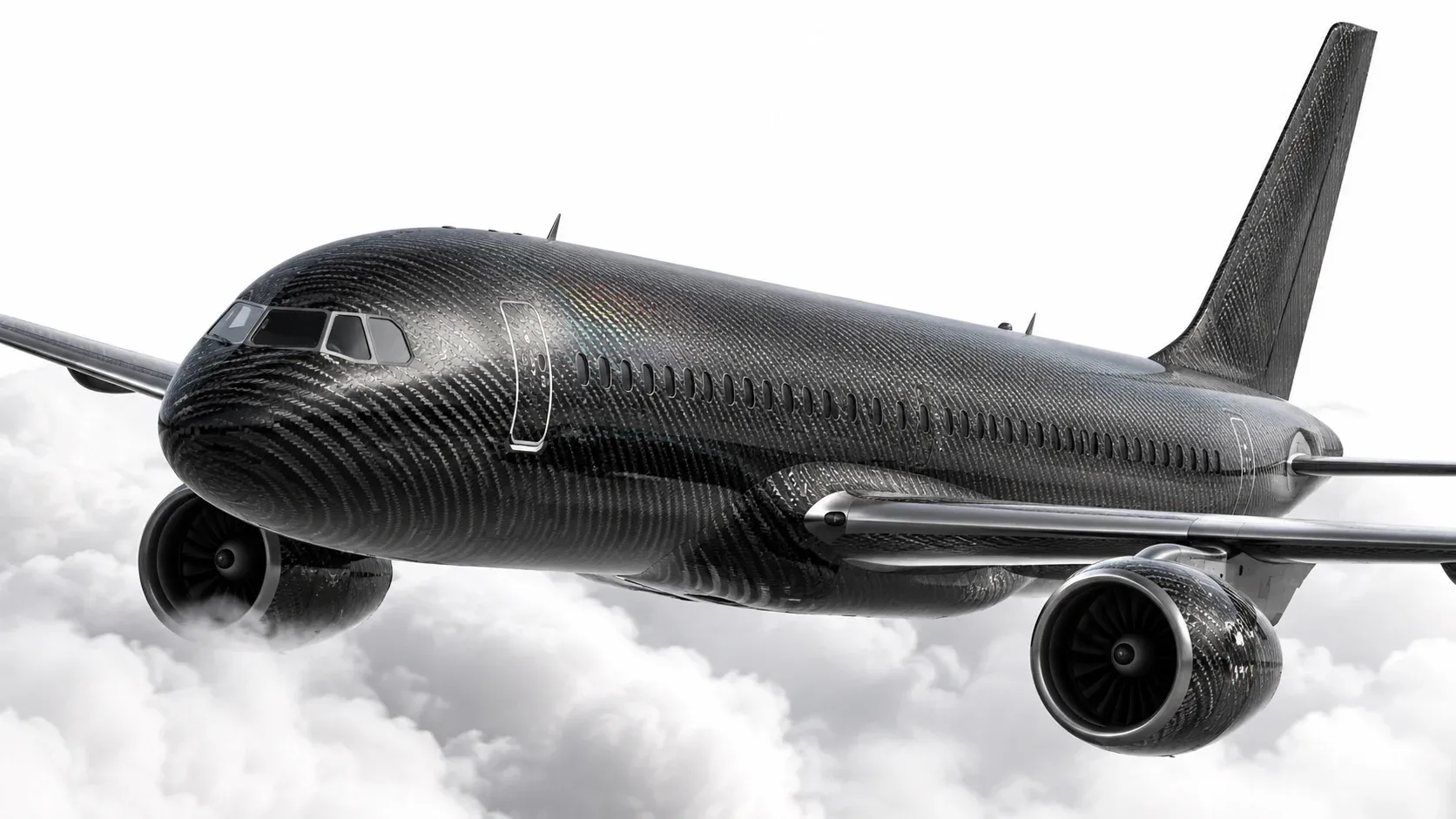
The twin-aisle 787 and A350 are already around half composite by weight. But the high-volume single-aisle jets, the A320 and 737 MAX, use comparatively little. The next narrow-body is where composites must scale, and that is exactly where the 100-a-month problem bites hardest.
The bottom line
For anyone specifying composites, the practical takeaway is that the conversation is shifting from what a material can do to how fast and how cleanly it can be produced at scale. Performance is increasingly a given. Manufacturability, supply security and lifecycle credentials are becoming the deciding factors.
Composites are strong enough; the question is whether they can be made fast enough, cleanly enough and at a price that holds. Thermoplastics are the most credible answer on the table, but cost, certification and a thin supply base mean the transition will be measured, not sudden.
100-a-month planning ambition: Reuters, March 2025.
Cure time and energy efficiency: US Department of Energy / Boeing.
Composite content by weight: published aircraft programme data, Hexcel white paper, 2026.
Specifying materials for an aerospace programme?
Talk through your programme with a specialist, or browse the prepregs, cores and structural adhesives behind our aerospace writing.
Book a consultation
Arrange a call with a specialist to discuss materials for your aerospace programme.
Choose a timeAerospace materials
Explore the carbon fibre prepregs, honeycomb cores and adhesives in our catalogue.
View products