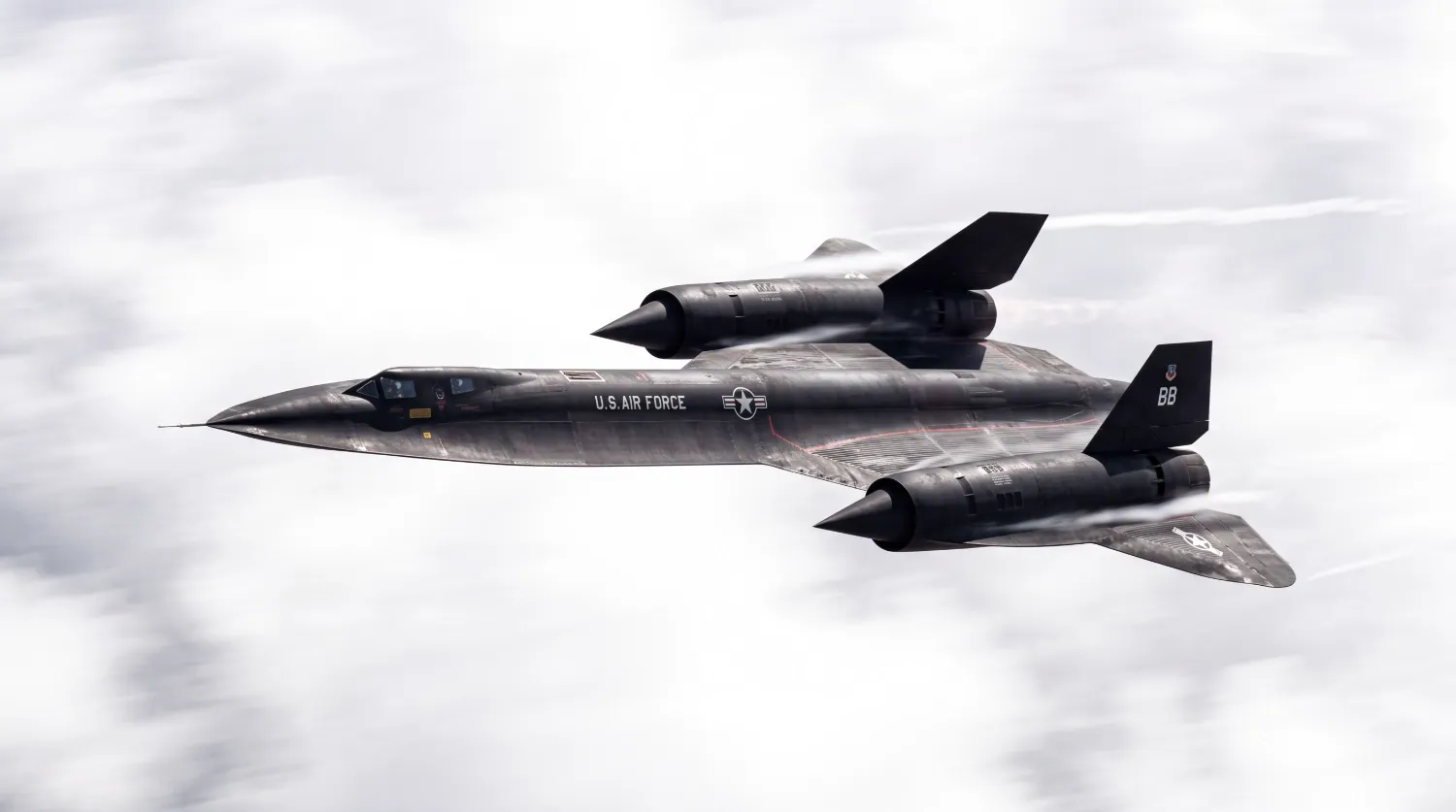
In 1959 Skunk Works accepted a CIA contract for an aircraft that would cruise above Mach 3 for hours at a time. No airframe material in production could survive it. What followed was one of the fastest periods of materials invention in engineering history, and one of the quietest.
A speed problem that was really a heat problem. Above Mach 3, the limit is not thrust but what the airframe is made of.
Sustained flight above Mach 3 heats an airframe the way re-entry heats a capsule, except that the heating lasts the length of a sortie rather than a few minutes. Air compressed against the leading edges gives up its energy as heat, and at the design point the structure soaks to temperatures no production aircraft had been asked to hold. Aluminium alloys, the basis of every airframe of the era, lose most of their useful strength long before those temperatures arrive.
Steel could take the heat but not the weight budget, which left titanium: a metal the industry had barely machined at production scale, now required to carry an aircraft that did not officially exist. The first A-12 flew from Groom Lake in April 1962, and the materials problems it dragged into the open went on to shape aerospace manufacturing for decades.2
Reading the airframe as a heat map. Where the temperatures settle at Mach 3.2, and what that rules out.
Forward fuselage
Minutes into cruise the forward fuselage settles at roughly 230 to 260 °C.1 Hot enough to anneal an aluminium skin; routine duty for titanium.
Chines and leading edges
Stagnation heating drives the edges past 300 °C. The same surfaces carry the radar-absorbing composite sections, holding laminates at temperatures no composite had seen in service before.
Canopy glazing
The glazing runs hot enough that crews famously pressed food against the inside of the windscreen to warm it on long sorties.3 Materials selection extended to the glass itself.
Nacelles and aft body
Peak structural temperatures sit around the engines and aft deck, climbing towards 565 °C near the exhaust.1 This is where material margins run thinnest.
The whole airframe
Every sortie was a complete furnace cycle, repeated across thousands of flight hours. The structure was designed around thermal soak rather than shielded from it.
Skin temperatures vary between declassified sources and with flight condition; the ranges shown are the values most commonly cited in the sources below.
Why titanium, and why the metal fought back. Choosing it was the easy part; building with it nearly broke the toolroom.
The alloy selected was B-120VCA, a beta titanium alloy that keeps useful strength at cruise temperature at a little over half the density of stainless steel. Around 85 per cent of the airframe’s structural weight is titanium, and most of the remainder is polymer composite: a split unheard of in 1962.1
Supply was its own covert operation. Ore of the required grade was scarce in the West, and supplies were quietly sourced through third countries and front companies, some of the ore originating in the Soviet Union: the country the aircraft was built to observe.2
Titanium, about 85 per cent
B-120VCA beta alloy across skin, frame and spar. Strength held at cruise temperature, without the weight penalty a steel structure would have carried.
Polymer composite, about 15 per cent
High-temperature laminates in the chines and the wing leading and trailing edges. The quiet first act of structural composites on an operational aircraft.
Share of structural weight as cited in Skunk Works (Rich, 1994).
Field notes from a new metal
The cadmium purge
Bolt heads began shearing off in service. The cause was traced to cadmium plating on ordinary workshop spanners, which embrittles hot titanium. Plated tools were withdrawn from the line entirely.1
The chlorine mystery
Spot welds made in summer kept failing while winter welds held. The difference was Burbank’s mains water, chlorinated seasonally and used to rinse panels. The line switched to distilled water.1
Relearning the drill
Titanium work-hardens as it is cut, and drill bits that would have lasted an entire aluminium airframe were destroyed within a handful of holes. Cutter materials, speeds and feeds were developed from scratch.1
An airframe built to be the wrong size on the ground. At cruise the structure grows by inches; every joint and tank was cut for the hot aircraft, not the cold one.
On the ramp
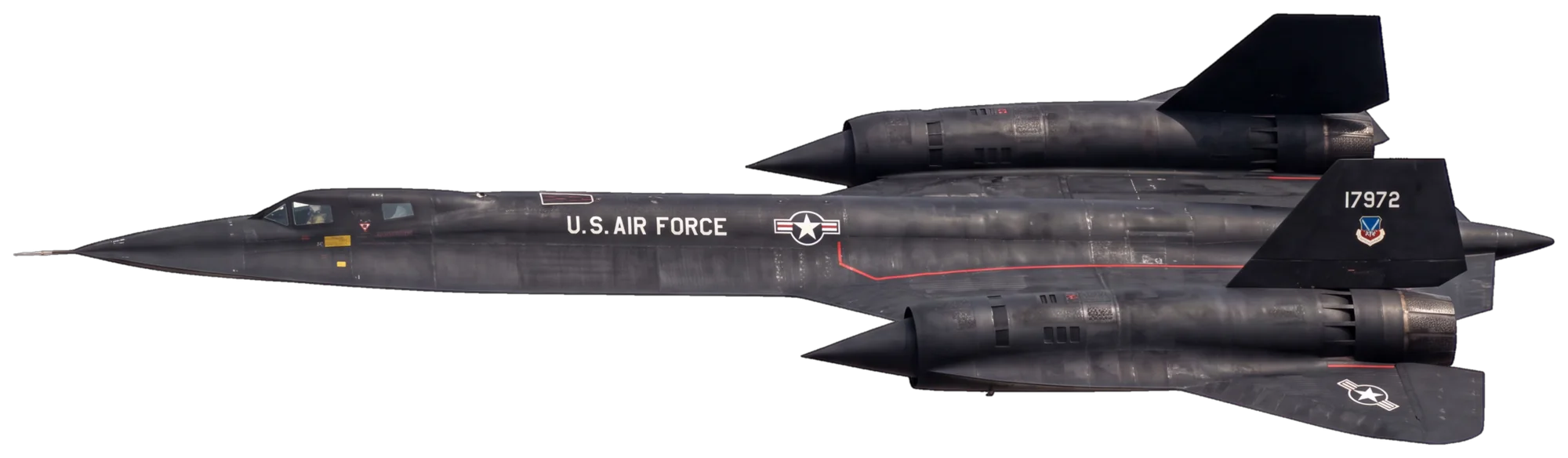
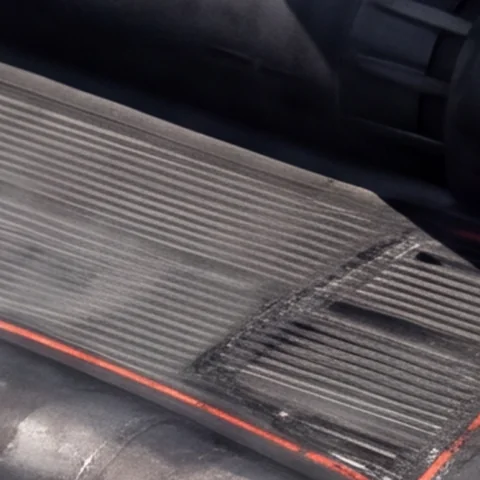
A serviceable Blackbird leaks. Panels sit gapped, the corrugated skins are slack, and JP-7 seeps from the tanks into drip trays. None of it is a fault; the airframe is simply not yet the shape it was designed to be.1
Through Mach 2
As the jet accelerates through Mach 2, friction heat spreads aft through the structure and the airframe begins to grow. Tolerances designed to be loose start closing.
At Mach 3.2
On station the fuselage runs several inches longer than it measured at engine start. Joints close, sealant beds down and the tanks finally seal.1
Fuel as coolant
JP-7 doubles as the heat sink, circulating through the aircraft to carry heat away from systems before it burns. The fuel specification is as much a thermal document as a chemical one.4
Why the skins are corrugated
The wing skins are corrugated so panels can expand chordwise without buckling. A smooth skin at these temperatures would wrinkle like foil. Critics mocked the ridges as a throwback to the Ford Trimotor, until the aircraft flew.1
Expansion is reported simply as “several inches” across the cited sources; the primary documents do not agree on a more precise figure.
The composite secret in plain sight. Load-bearing, radar-absorbing laminates flying at Mach 3 a decade early.
The chines along the fuselage and the wing leading and trailing edges are not titanium. They are high-temperature composite sections: asbestos-reinforced laminates loaded with iron ferrite, shaped internally to absorb and scatter radar energy while carrying aerodynamic load at temperatures far beyond anything else composites were being asked to survive.2 Flying operationally in the early 1960s, the A-12 has a fair claim to being the first serious structural-composite airframe.
Even the paint is a materials system. The black finish is loaded with iron particles to soak up radar energy, and its high emissivity radiates heat away, taking a useful margin off skin temperature.3 The colour that named the aircraft was a thermal and electromagnetic decision before it was an aesthetic one.
Chine edge build-up, schematic only and not to scale. Layer composition as described in the declassified programme histories cited below.
A. High-emissivity ferrite paint
Radiates heat away and absorbs radar energy at the surface. Finish as function, not decoration.
B. Absorbing composite wedge
Asbestos-reinforced laminate with iron ferrite loading, shaped internally to trap and dissipate radar energy while carrying flight loads at cruise temperature.
C. Titanium substructure
B-120VCA spar and rib structure behind the edge, taking the composite sections’ loads into the airframe.
What the Blackbird left behind. Materials knowledge that outlived the programme by decades.
Titanium at production scale
Machining knowledge, cutter technology and forming practice developed for the programme seeded the titanium supply chain that modern airframes and engine components still depend on.
Structure that absorbs
The move from radar-absorbing paint to radar-absorbing structure begins here. Every low-observable airframe since has carried the idea forward into engineered composite edges and skins.
Heat as a design input
Fuel as heat sink, expansion joints, high-emissivity finishes: thermal management treated as a materials discipline, an approach now standard from engine hot sections to building envelopes.
Sixty years on, selecting materials against thermal, structural and electromagnetic constraints at once remains the core of advanced materials engineering. The difference is access. What programme engineers learned across years of failures, accredited materials testing and analysis can now establish in days, for aerospace and for every sector beyond it.
Sources. The declassified record behind this article.
- Rich, B. and Janos, L., Skunk Works: A Personal Memoir of My Years at Lockheed. Little, Brown, 1994.
- Robarge, D., Archangel: CIA’s Supersonic A-12 Reconnaissance Aircraft. Central Intelligence Agency, declassified official history.
- Merlin, P. W., Design and Development of the Blackbird: Challenges and Lessons Learned. AIAA, 2009.
- NASA Armstrong Flight Research Center, SR-71 Blackbird fact sheet.
- Pedlow, G. and Welzenbach, D., The CIA and the U-2 Program, 1954 to 1974. Central Intelligence Agency, declassified history.
Specifying materials for an aerospace programme?
Talk through your programme with a specialist, or browse the prepregs, cores and structural adhesives behind our aerospace writing.
Book a consultation
Arrange a call with a specialist to discuss materials for your aerospace programme.
Choose a timeAerospace materials
Explore the carbon fibre prepregs, honeycomb cores and adhesives in our catalogue.
View products