The gutter sensor monitors roof gutters and drainage for standing water. It detects a blockage early, sends its readings to the monitoring portal over the mobile network and raises an alarm when a threshold is exceeded, before the building is damaged. It is solar powered and retrofitted to the gutter, or to the roof drain on a flat roof.
What it measures
Three things, typically once an hour, with the interval adjustable remotely:
- Standing water in the gutter, through a capacitive probe that lies on the gutter bottom.
- Rainfall, through a reference pad on the bracket.
- Temperature, recorded as a frost warning.
How a blockage is detected
Rain alone says little and standing water alone says little. Combining the rainfall reference with the moisture reading in the gutter is what makes detection reliable: water that stands while no rain is falling is the signal.
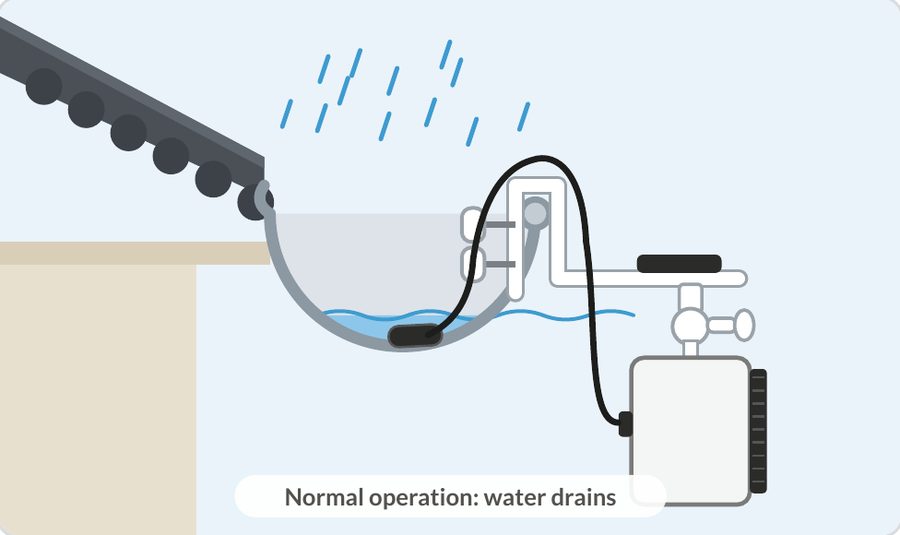
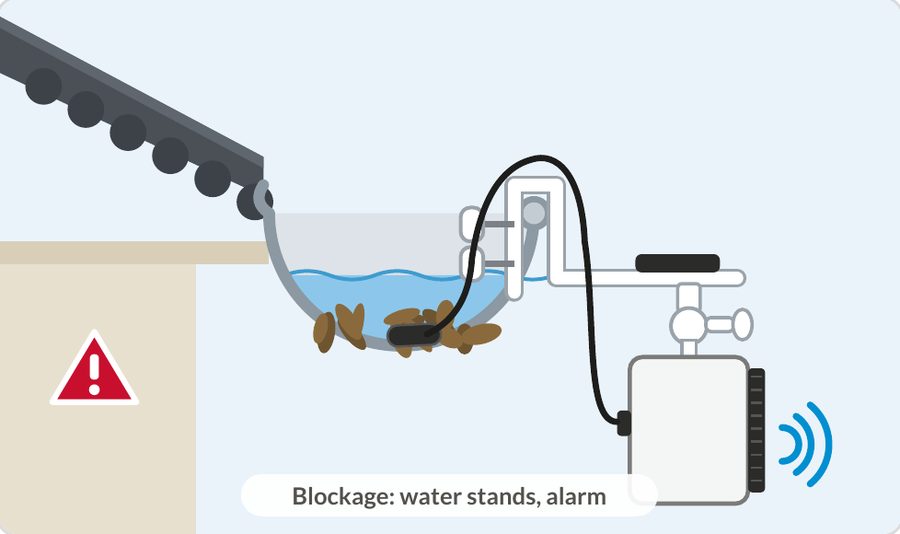
An alarm also goes out if the water exceeds a set level. Alarms arrive by email or SMS, or into a building management system where that has been set up, and the readings behind them are in the portal.
The five parts
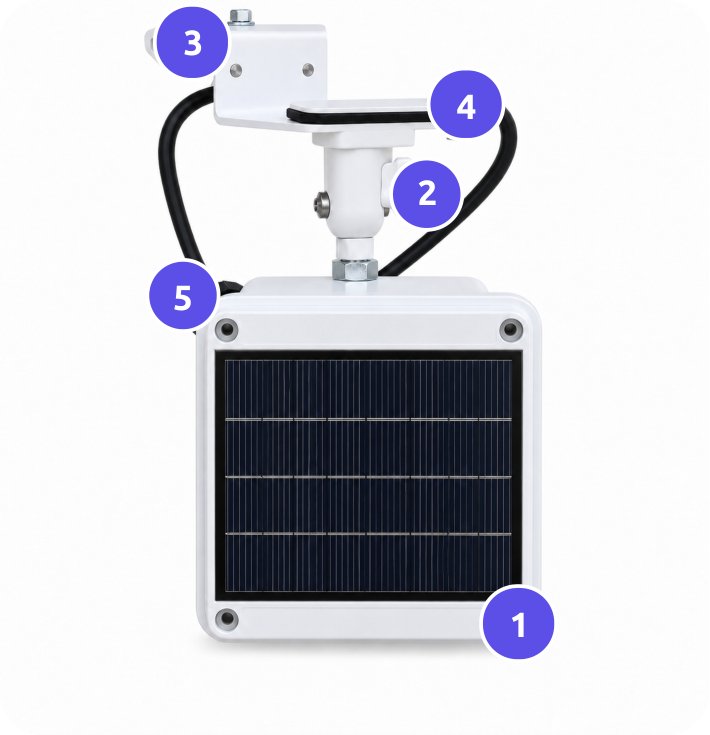
- Gateway with solar panel. The electronics and the NB-IoT or LTE Cat-M transmitter in one weatherproof housing, powered by the solar panel on its face. The device ID is on the label.
- Swivel mount. A ball joint with a thumbscrew, so the panel can be turned through 360 degrees to face the light.
- Clamp bracket. A U-profile with two thumbscrews that clamps onto the front edge of the gutter. No drilling. The clamp and the sensor cable length can be adapted to suit different gutter profiles, valley gutters included.
- Rainfall reference. A black sensor pad on the bracket that records current rainfall, so standing water can be told apart from rain. Keep it exposed and uncovered.
- Sensor cable with probe. The probe lies on the gutter bottom and detects standing water.
Power and connection
The gateway charges from daylight and holds 40 to 50 readings in reserve without sun, so there is no battery to change on the roof and nothing to wire. Readings travel over NB-IoT or LTE Cat-M on the included international SIM, which covers the UK and Ireland with no local contracts.
Where it fits
Roof gutters are the standard installation. The same unit can be fitted at the drain of a flat roof, where there is no gutter, using one of three mounting methods agreed with Allbase before fitting. See Fitting the gutter sensor on a flat roof.
Next steps
- Installing the gutter sensor on a roof gutter
- Gutter sensor: operation, maintenance and removal
- Gutter sensor product page, with the full technical data and the product sheet